
Why Late-Interaction Retrieval Is Strictly More Expressive, A Survey and Framework for Agentic Recommender Systems, and More!
Vol.164 for Jul 06 - Jul 12, 2026

Stay Ahead of the Curve with the Latest Advancements and Discoveries in Information Retrieval.
This week’s newsletter highlights the following research:
Quantifying and Expanding the Theoretical Capacity of Late-Interaction Retrieval Models, from UMass Amherst
A Survey and Framework for Agentic Recommender Systems, from Lin et al.
Lightweight Candidate Retrieval via Heavy-Ranker Calls, from Yandex
A Unified Framework for Semantic ID Generation and Multi-Objective Ranking, from Alibaba
From Passive Retrieval to Active Memory Navigation, from Alibaba
Temporal Gap Tokenization for Generative Recommendation, from Huang et al.
A Deterministic Environment for Self-Improving Web Agents, from Geng et al.
Time Intervals as a Modality for Multi-Modal Sequential Recommendation, from Wang et al.
How Should Capacity Be Distributed Across Roles in Hierarchical Search Agents?, from ECNU
Long-Term Optimization for Large-Scale Generative Retrieval with Off-Policy REINFORCE, from AI VK
[1] Quantifying and Expanding the Theoretical Capacity of Late-Interaction Retrieval Models
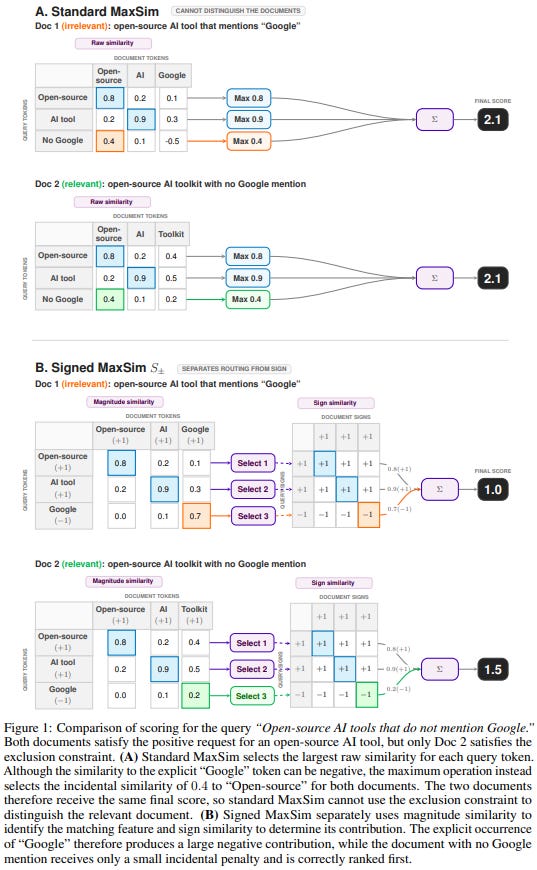
This paper from UMass Amherst explores late-interaction retrieval models like ColBERT and asks: why does the MaxSim similarity function work so well, beyond just giving models more room to represent data? The authors prove that MaxSim can exactly reproduce the inner product between any two non-negative sparse vectors, even ones with infinite dimension, using only O(k) space where k is the number of nonzero elements. They construct this by mapping each vector entry to a 3-dimensional embedding and using a quadratic polynomial trick so the max operation only lets matching indices contribute. They then show a hard limit that standard MaxSim cannot replicate inner products between arbitrary real-valued vectors under a sparsity-preserving encoding, because negatives break the construction. To fix this, they introduce Signed MaxSim, which splits each value into magnitude and sign, keeps them separate through the max step, and reattaches the sign afterward, recovering exact inner products for any real vectors. They also prove that no finite-dimensional single-vector inner product can preserve inner products of arbitrarily high-dimensional sparse vectors, while MaxSim can, and show MaxSim naturally behaves as a weighted fuzzy OR and can evaluate positive CNF Boolean queries in a rank-equivalent way. They train a model called Fallon using Signed MaxSim on synthetic retrieval tasks built around negation queries. It beats a standard ColBERT baseline everywhere, with the gap widening out of domain.
📚 https://arxiv.org/abs/2607.05803
[2] Autonomous Information Seeking: A Roadmap for Agentic Recommender Systems
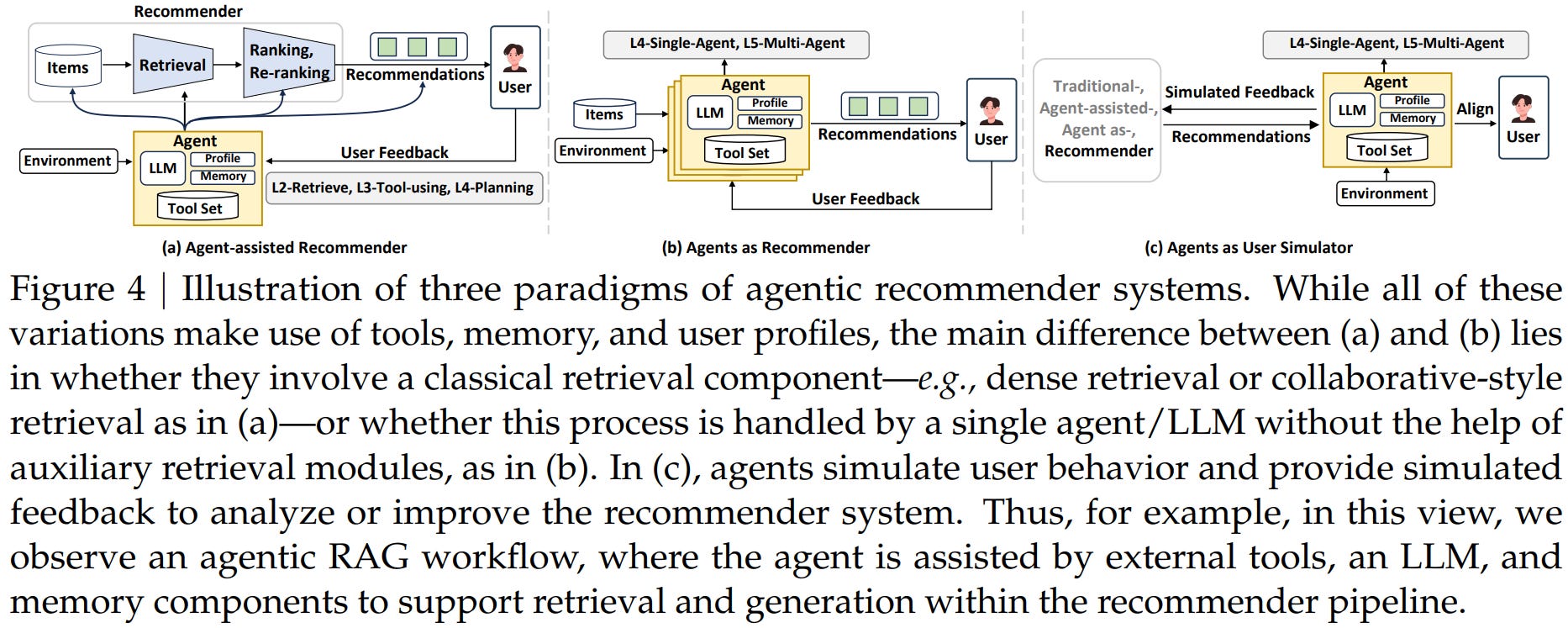
This paper from Lin et al. surveys the emerging field of agentic recommender systems, where LLM-based agents that reason, plan, use tools, and hold memory replace or augment the static ranking pipelines that have long dominated recommendation. The authors organize the literature along two axes. The first is a level-of-autonomy scale, running from passive rankers (L0) up through retrieval grounding, tool orchestration, single-agent planning, and multi-agent coordination (L5). The second is three macro roles based on where the agent sits: agent-assisted recommendation, where the agent supports a classical recommender; agent-as-recommender, where it takes over end-to-end and demotes classical models to tools; and agent-as-user-simulator, where agents mimic users or environments to generate training and evaluation data. For each role, they break systems into recurring parts (profile, memory, tool use, workflow, optimization) and cover control patterns like ReAct, plan-then-execute, and reflexion, plus coordination schemes like manager-worker and debate-judge. A large part of the paper argues that evaluation has lagged behind architecture. Most work still reports only ranking metrics like NDCG, even when the real contribution is planning or memory. They push instead for trajectory-level evaluation that separates final recommendation quality from the process behind it, covering grounding, tool traces, simulator validity, safety, privacy, and cost, backed by a reporting checklist.
📚 https://arxiv.org/abs/2607.04433
[3] Relevance-Based Embeddings: Lightweight Candidate Retrieval via Heavy-Ranker Calls
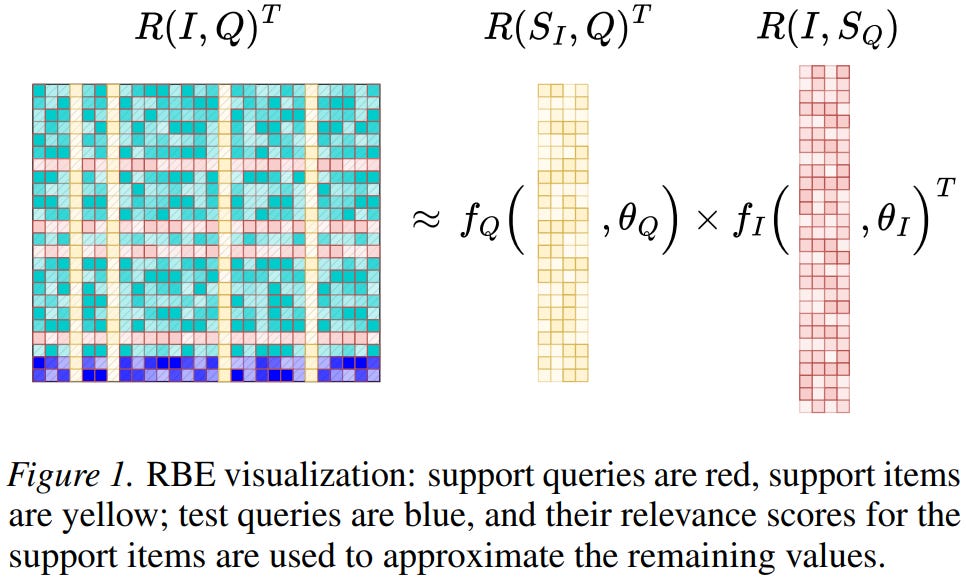
This paper from Yandex introduces relevance-based embeddings (RBE), a method for retrieving the most relevant items for a query without running an expensive ranking model over the whole catalog. The core idea is that instead of embedding queries and items separately in a shared space like a standard dual encoder, you describe each query by its relevance scores against a small fixed set of support items, and each item by its scores against a set of support queries. These relevance vectors, computed by calling the heavy ranker only on the support set, then get passed through lightweight neural networks to produce embeddings usable in fast approximate nearest neighbor search. The authors prove that under mild conditions these embeddings can uniformly approximate any continuous relevance function, which means RBE captures pairwise query-item signals that dual encoders structurally cannot. Another contribution is showing that the choice of support items matters a lot. Prior work sampled them at random, but the paper demonstrates that clustering approaches (KMeans) and especially a theoretically grounded greedy method that directly minimizes CUR approximation error (l2-greedy) beat random selection by wide margins. Their experiments include span entity linking, question answering, and two production recommendation services at Yandex, and RBE consistently outperforms the AnnCUR and AXN baselines while using far fewer trainable parameters and less training data.
📚 https://arxiv.org/abs/2607.03515
👨🏽💻 https://github.com/shevkunov/Relevance-Based-Embeddings-Lightweight-Candidate-Retrieval
[4] UniSGR: Unified Framework for Semantic ID Generation and Ranking
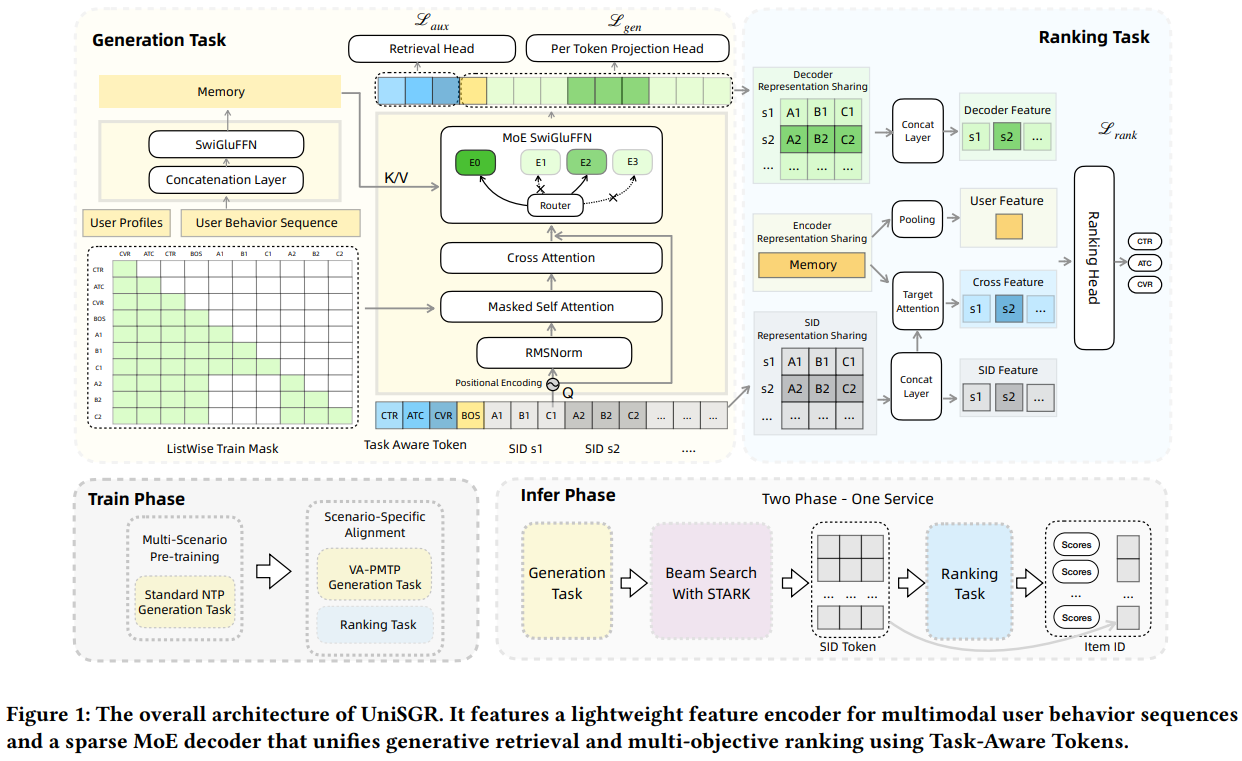
This paper from Alibaba introduces UniSGR, a framework that merges generative retrieval and multi-objective ranking into a single model for e-commerce recommendation. The motivation is that traditional cascade pipelines optimize retrieval, pre-ranking, and ranking separately, so relevant items dropped early can never be recovered, and even newer generative retrieval methods pick semantically plausible candidates without the fine-grained ranking discrimination that industrial systems need. UniSGR tackles this with a two-stage training recipe borrowed conceptually from foundation models: multi-scenario pre-training on mixed business-scenario logs to learn broad user interests, followed by scenario-specific alignment that jointly trains generation and ranking on the same semantic ID representations. Items are tokenized into a balanced 3-layer semantic codebook via a fine-tuned Qwen3-VL encoder and RQ-VAE. Value-Aware Parallel Multi-Token Prediction biases generation toward higher-value behaviors like purchases rather than just clicks. Task-Aware Tokens, guided by a funnel-aware contrastive loss, prepend learnable click/add-to-cart/purchase tokens so the decoder conditions on which business objective it’s serving. A ranking module reuses the decoder’s hidden states instead of running a separate ID-based ranker. On the systems side, they propose an inference trick that swaps beam search’s batch-dimension expansion for a sequence-dimension tree attention mask, deduplicating shared prefixes in the KV cache and roughly tripling throughput. The architecture itself is an asymmetric encoder-decoder with a lightweight linear-complexity feature encoder and a sparse MoE decoder. UniSGR beats TIGER, OneRec, and OneRec-V2 across hit-rate metrics, shows clean scaling from 0.2B to 2.0B parameters, and an online A/B test lifted GMV by 5.68%.
📚 https://arxiv.org/abs/2607.04068
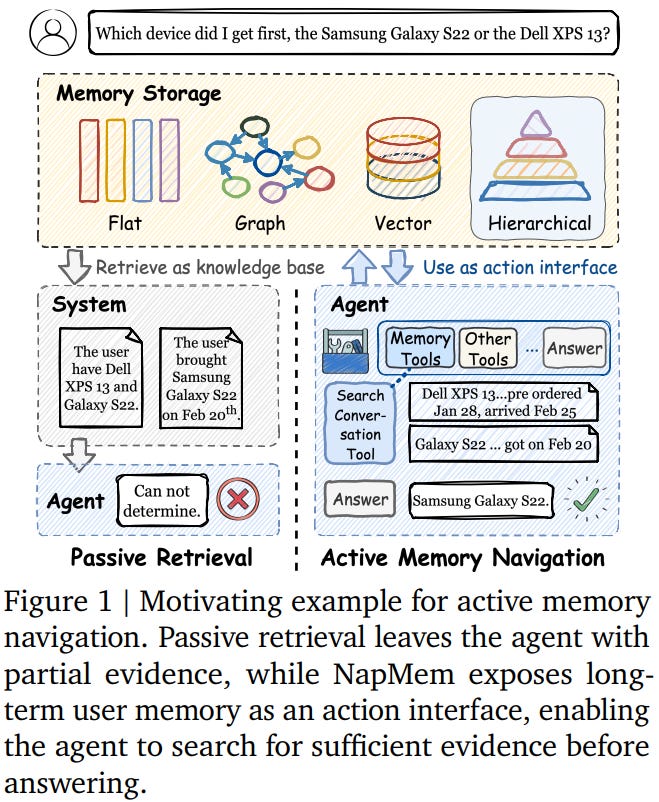
[5] From Passive Retrieval to Active Memory Navigation: Learning to Use Memory as a Structured Action Space
This paper from Alibaba introduces NapMem (Navigate over Pyramid Memory), which reframes long-term user memory as something an agent actively navigates rather than passively receives. Instead of handing the model pre-retrieved context, the authors organize each user’s history into a four-level pyramid: raw conversations at the base, then compact typed memory records (facts, events, instructions, preferences), topic tracks that aggregate across sessions, and a global user profile at the top. These levels connect through provenance links, so the agent can move up to a summary or drill back down to source evidence. The agent learns when and how to use tools through reinforcement learning (GRPO with a terminal reward covering answer correctness, format, and tool use). Trained on a 9B Qwen model, NapMem beats larger untrained variants and five memory-system baselines (Mem0, Zep, MemOS, MemoryOS, AgeMem) across three memory benchmarks. On efficiency, it uses less storage than most baselines and produces shorter, faster completions by stopping once it has enough evidence.
📚 https://arxiv.org/abs/2607.05794
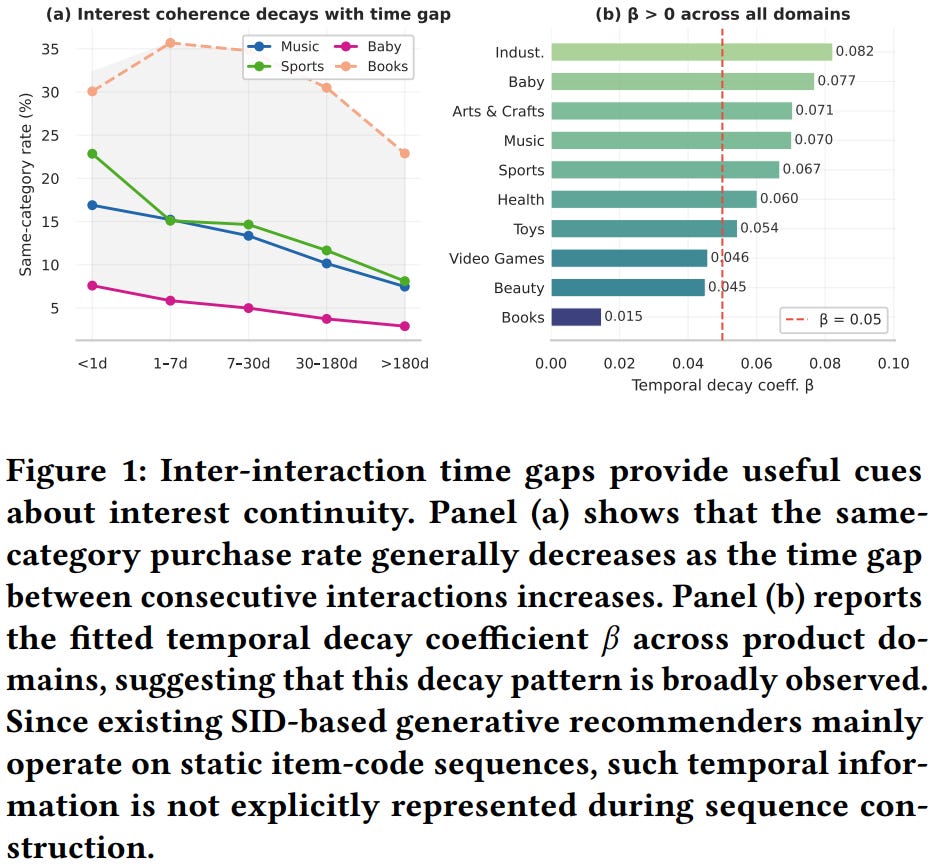
[6] Beyond Item Order: Temporal Gap Tokenization for Generative Recommendation with Semantic ID
This paper from Huang et al. introduces ChronoSID to tackle a blind spot in semantic-ID-based generative recommendation: these models represent items as short discrete code sequences and predict the next item as code generation, but they treat user history as a bare ordered list of item codes and throw away the elapsed time between interactions. The authors show this matters, since same-category purchase rates drop steadily as the gap between interactions grows across Amazon domains, signaling that time carries real cues about interest continuity and preference drift. Their fix incorporates temporal signals into the standard three-stage ReSID pipeline at two points. First, they add an auxiliary time-gap prediction objective to masked item-feature reconstruction, regularizing item representations to be temporally predictable before quantization. Second, they bin each inter-interaction interval into one of five fixed log-scale gap tokens (thresholds at 1h, 1d, 1w, 1mo) and interleave those tokens with the semantic ID tuples feeding the T5 encoder, so each historical item contributes one gap token plus three code tokens. In their experiments, ChronoSID beats ReSID and other generative baselines (TIGER, LETTER, EAGER, UNGER, ETEGRec).
📚 https://arxiv.org/abs/2607.03918
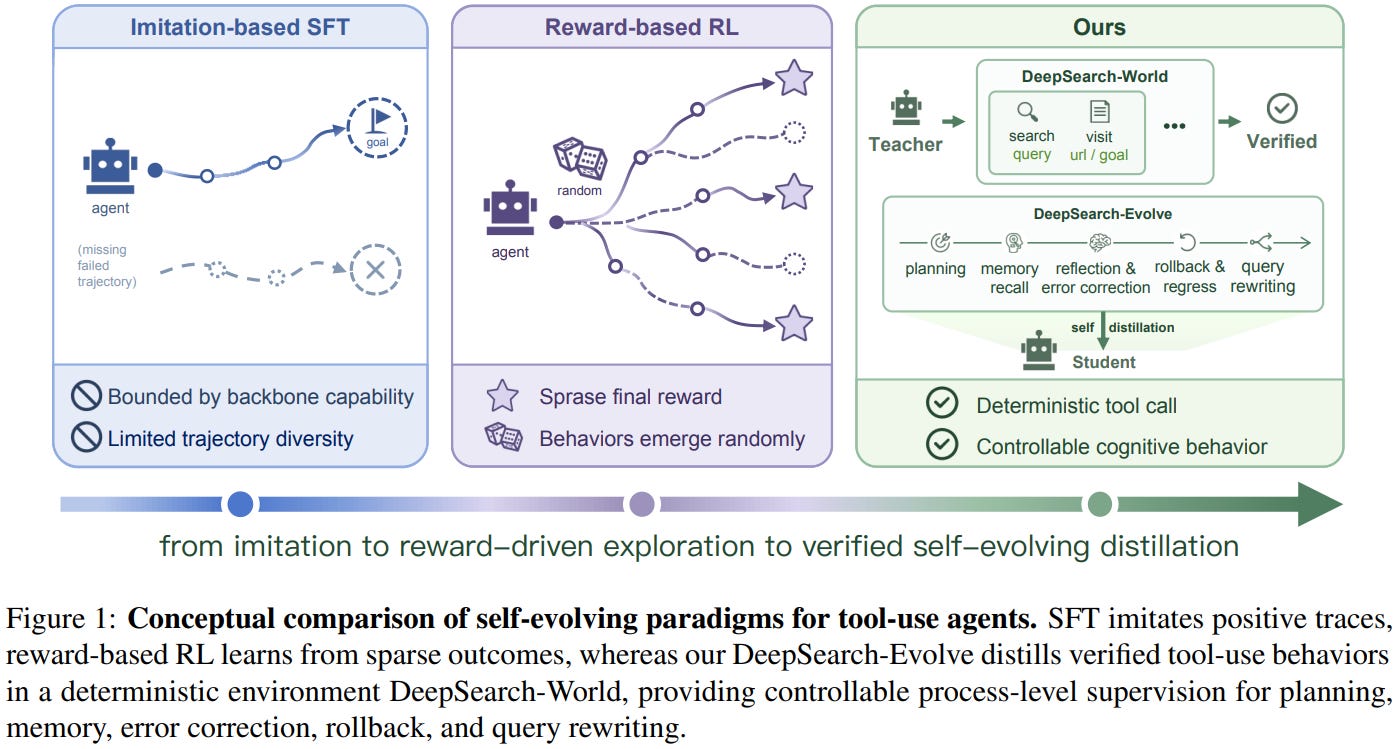
[7] DeepSearch-World: Self-Distillation for Deep Search Agents in a Verifiable Environment
This paper from Geng et al. tackles a hard problem in training web-search agents. Supervised fine-tuning gets capped by the backbone model’s own ceiling, while reinforcement learning gives feedback that’s too sparse to show where a long multi-step search actually went wrong. The authors’ solution is DeepSearch-World, an offline Wikipedia environment with deterministic search and page-reading tools plus 420K multi-hop QA tasks built from entity-level random walks. Because the environment stores the ground-truth entities behind each question, it can verify progress after every tool call without relying on an LLM judge. On top of this, they build DeepSearch-Evolve, a self-distillation loop where a scaffolded teacher agent generates trajectories that get filtered by answer-correctness and quality, then rewritten into standard ReAct format so the student learns the planning and error-recovery behavior without needing the scaffold at inference. The model teaches itself round after round rather than distilling from a stronger proprietary teacher. The resulting DeepSearch-World-9B, trained from Qwen3.5-9B over 11 evolving rounds, goes well past its backbone and performs well against open-source agents that lean on synthetic data from frontier models.
📚 https://arxiv.org/abs/2607.07820
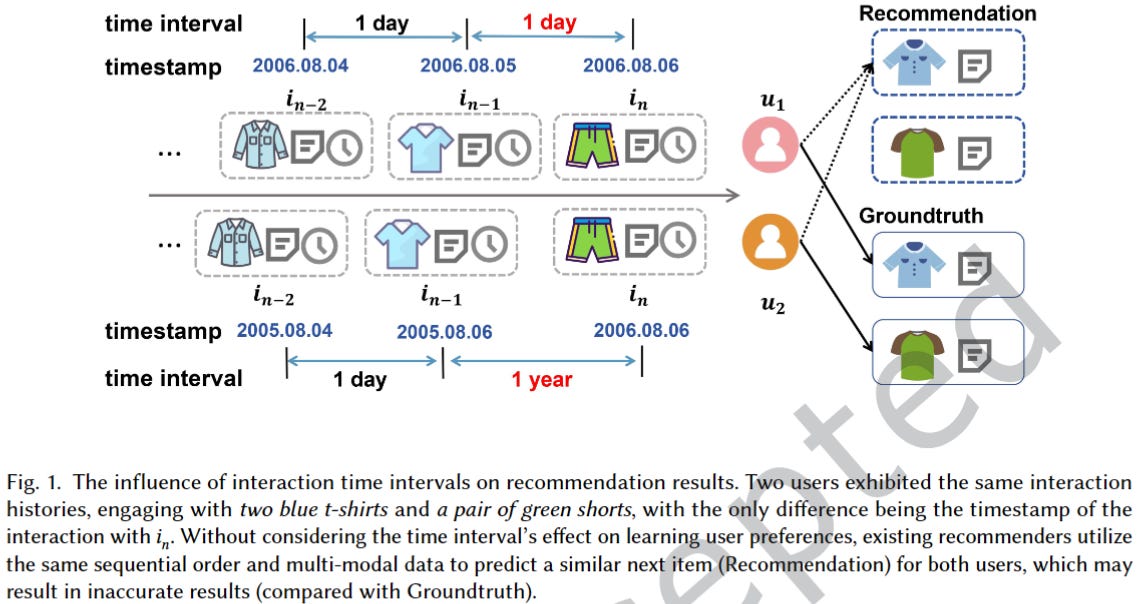
[8] TMMSRec: Time-interval-aware Multi-Modal Sequential Recommender
This paper from Wang et al. argues that multi-modal sequential recommenders fall short on utilizing the time gaps between a user’s interactions as a useful signal. Two people can click the same items in the same order, but if one did it over a week and the other over a year, their next-item preferences likely differ. Existing models often ignore this, so the authors propose TMMSRec, which treats the time interval as a fourth modality alongside ID, text, and image. The core idea is a Time Interval Encoder (TIE) that buckets each timestamp into day, month, and year components and encodes them with a block-diagonal sinusoidal rotation matrix, so the model can pick up short-term, medium-term, and seasonal rhythms rather than collapsing everything into one scale. The authors use a two-stage fusion strategy. The first stage injects the time signal into each modality separately (each gets its own SASRec encoder), and the second stage adds the per-modality preference scores together at the end. The reasoning is that the three content modalities come from different feature extractors and live in heterogeneous spaces, so fusing them early causes interference; keeping them apart until scoring avoids that. Across four datasets (three Amazon categories plus MovieLens-1M), TMMSRec beats a large slate of sequential, multi-modal, and time-aware baselines.
📚 https://dl.acm.org/doi/10.1145/3827608
👨🏽💻 https://github.com/wangpp0602/TMMSRec
[9] Think Big, Search Small: Where Capacity Matters in Hierarchical Search Agents?
This paper from ECNU asks when you split a search agent in multi-agent search systems into a planner and a set of sub-agents, how much model capacity does each role actually need? The authors break hierarchical search into three roles: a delegation backbone that decomposes the question into sub-queries, an execution sub-agent that retrieves and reads within its own isolated context, and a fixed answer generator that they hold constant to rule out confounds. They then run controlled capacity sweeps along the delegation and execution axes across five multi-hop QA benchmarks. They share three findings:
Splitting the task into separate roles beats a single-agent baseline at every model scale, lifting exact match by 4.5 to 8.6 points, with the biggest gains for weaker models.
The two roles are wildly asymmetric in how much they care about capacity: scaling the backbone moves EM by around 11 points, while scaling the executor moves it by only about 2.6, which shows decomposition as the real bottleneck.
They train a 1.7B executor through quality-filtered trajectory distillation, targeting the one skill small models lack (recognizing when a first retrieval failed and reformulating), and it matches a frontier sub-agent while burning 37% fewer tokens.
The practical takeaway is that in multi-agent retrieval systems, capacity should be focused in the planner and the executor should be small and specialized.
📚 https://arxiv.org/abs/2607.07548
👨🏽💻 https://github.com/QinnanCai0115/role-factorized-search
[10] Long-Term Optimization for Large-Scale Generative Retrieval with Off-Policy REINFORCE
This paper from AI VK tackles a mismatch in how large-scale recommenders get trained. Generative retrievers usually learn through supervised next-item prediction, which chases immediate clicks rather than long-term user satisfaction. The authors reframe recommendation as session-level sequential decision-making and train a generative retriever with off-policy REINFORCE on pre-collected data, representing items as dense embeddings instead of semantic IDs. The authors create an autoregressive setup that processes a whole user sequence in one forward pass, which lets them compute a multi-step approximation of the importance weights, rather than the single-step off-policy correction used in prior REINFORCE recommenders. To evaluate offline (which is the genuinely hard part here), they train a user feedback model that simulates whether a user would like a track and how much they’d listen, then use it to run doubly robust off-policy evaluation adapted to the sequential setting, which recommenders have barely explored. That same feedback model powers a test-time scaling trick. At inference, they roll out several candidate future trajectories, score each by predicted discounted return, and return the first item of the best one, spending extra compute to chase long-term reward without retraining. On the public Yambda-5B dataset (five billion interactions), the RL agent beats next-item and next-positive baselines on off-policy estimates of cumulative session reward, and more inference-time rollouts reliably lift the model-based return estimates. The caveat is that everything is offline: the test-time scaling gains are measured with the same feedback model that guides selection, so this isn’t independent proof that real users are happier.
📚 https://arxiv.org/abs/2607.02818
Extras: Benchmarks
⏱️ CMDR: Contextual Multimodal Document Retrieval
CMDR-Bench is a benchmark for contextual multimodal document retrieval that evaluates whether retrieval systems can identify relevant pages by leveraging information distributed across multiple pages, rather than relying on direct lexical or semantic matches within individual pages. The benchmark contains 800 manually annotated queries spanning 255 long documents from six domains, with queries covering text completion, coreference resolution, structured understanding, and multi-hop reasoning. It is designed to assess retrieval scenarios where resolving a query requires modeling document-level context across visually rich, multi-page documents.
📝 https://arxiv.org/abs/2607.05927
👨🏽💻 https://cmdr-bench.github.io/
⏱️ WebRetriever: A Large-Scale Comprehensive Benchmark for Efficient Web Agent Evaluation
WebRetriever is a benchmark for evaluating web agents in live online environments. It contains 1,550 tasks spanning 800 real websites across consumer and professional domains, with tasks designed to cover a broad range of user intents. In addition to the benchmark itself, the authors introduce NavEval, an automated evaluation method that uses interaction traces and browser requests alongside screenshots, and defines three evaluation protocols that separately measure navigation, navigation with operational guidance, and end-to-end task completion involving information extraction.
📝 https://arxiv.org/abs/2607.06118
👨🏽💻 https://github.com/Mininglamp-AI/WebRetriever
I hope this weekly roundup of top papers has provided you with valuable insights and a glimpse into the exciting advancements taking place in the field. Remember to look deeper into the papers that pique your interest.
I also blog about Machine Learning, Deep Learning, MLOps, and Software Engineering domains. I explore diverse topics, such as Natural Language Processing, Large Language Models, Recommendation Systems, etc., and conduct in-depth analyses, drawing insights from the latest research papers.