
Do RAG Retrieval Enhancements Help Once a Strong Reranker Is Present?, Self-Evolving Agentic Recommender Systems, and More!
Vol.163 for Jun 29 - Jul 05, 2026

Stay Ahead of the Curve with the Latest Advancements and Discoveries in Information Retrieval.
This week’s newsletter highlights the following research:
Do RAG Retrieval Enhancements Help Once a Strong Reranker Is Present?, from Cascade Research
Automating Recommender Optimization with Self-Evolving Agents, from Alibaba
A Geometric Test for Choosing Text Embedding Similarity Metrics, from V. Parupudi
A Generative Reasoning Re-Ranker for Industrial Recommendation, from Meta
A Mechanistic Account of RAG Attribution, from University of Amsterdam
Stateful Graph Navigation for Large-Scale Recommendation Retrieval, from Kuaishou
Why Modern Encoders Lag on Sparse Retrieval, and How to Fix It, from AWS
Corpus-Scale In-Context Retrieval at Million-Token Scale, from Gollapudi et al.
The Case for Local-First Information Retrieval, from Zerhoudi et al.
Constructive Multi-Sequence Learning for Recommendation, from Meta
[1] Beyond the Reranker: Do RAG Retrieval Enhancements Help Once a Strong Reranker Is Present?
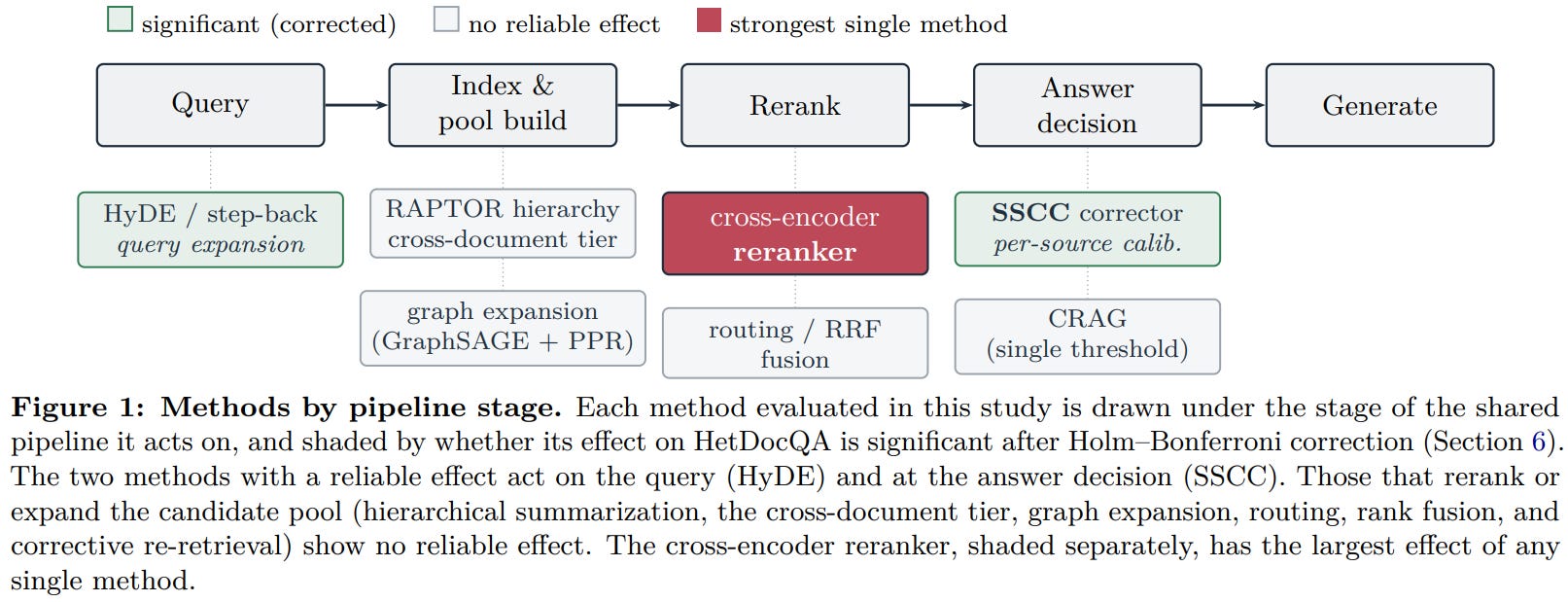
This paper from Cascade Research asks if the many popular retrieval enhancements actually still help once you’ve added a strong cross-encoder reranker to a RAG pipeline? Most evidence for methods like query expansion, hierarchical summarization, graph expansion, routing, and rank fusion comes from homogeneous corpora (mostly Wikipedia prose), so the authors built HetDocQA, a benchmark whose collections mix code, markdown, prose, tables, and scientific PDFs. It uses character-span relevance labels matched to each system’s own chunks at evaluation time, which makes retrieval scores independent of how a system segments the corpus, and it splits data disjointly by collection so tuned thresholds can’t exploit recurring structure. They ran eight methods on a shared backbone (fixed embedder, reranker, and generator), paired HetDocQA with MuSiQue and QASPER as controls, and applied bootstrap confidence intervals with multiple-comparison correction. They find that the reranker carries almost all the retrieval quality, and beyond it only two methods give reliable gains: query expansion (HyDE), which helps when the question and evidence share little surface vocabulary, and SSCC, a per-source calibrated corrector that sets a separate acceptance threshold for each score source and helps only on heterogeneous data. Everything else that reranks or expands the candidate pool (RAPTOR, cross-document summarization, graph expansion, routing, rank fusion, corrective re-retrieval) shows no reliable improvement once the reranker is present, with the intuition being that a good reranker has already ordered a pool that contains the answer, leaving room to help only at the input (what enters the pool) and the answer decision (what gets accepted).
📚 https://arxiv.org/abs/2606.28367
👨🏽💻 https://github.com/qarkapp/sscc-rag-paper
[2] EvoRec: Self Evolving Agentic Recommender Systems
This paper from Alibaba tackles a bottleneck that in industrial recommender systems optimization still leans on engineers tuning models by hand, which is slow and capped by individual expertise. The authors argue that prior LLM-agent approaches fall short in three ways: they use the agent only as a code translator, they freeze their skill or memory modules after deployment, and they confine the search to predefined hyperparameter spaces that can’t introduce structurally new ideas. EvoRec answers this with a multi-agent framework that co-evolves both the recommendation model and the methodology that optimizes it. Four agents run a dual-track loop: an Orchestrator coordinates everything, a Research Agent generates optimization hypotheses by pulling from external sources (like arXiv) and weighing them against past successes and failures, a Code Agent turns each hypothesis into minimal-diff code changes and submits training, and a Skill Evolver periodically distills reusable methodology from a persistent, structured Memory that records the full trajectory of every round (hypothesis, code diff, logs, metrics, and success/failure attribution). On a large industrial dataset (~2.95B interactions), EvoRec lifts offline metrics up to 5.54% over the strongest baseline across both ID-based and generative recommenders, and a 7-day A/B test delivers a 1.85% revenue lift and 1.02% CTR gain.
📚 https://arxiv.org/abs/2606.28368
[3] Anisotropy Decides Cosine vs. Rank Metrics for Text Embeddings
This paper from V. Parupudi investigates when does a similarity metric other than cosine actually work better for comparing text embeddings? Testing 19 parameter-free metrics against 19 encoders (from small sentence transformers to 7B-parameter LLMs) across 7 datasets, the authors find a split. On encoders whose embeddings spread evenly across dimensions, cosine wins and nothing beats it by a meaningful margin. On encoders where variance concentrates into a few dominant directions (anisotropy), rank-based and L1-type metrics (like Spearman rank correlation, Canberra, and Manhattan distance) beat cosine by around 0.05 in Spearman correlation, which translates to roughly a 20% relative improvement since cosine’s baseline is already weak there. Crucially, this split tracks encoder geometry rather than training method. E5-Mistral was trained with a cosine objective yet stays anisotropic, while multilingual BERT was never trained that way yet ends up well-spread, and each behaves according to its geometry, not its training label. The authors rule out model size, pooling strategy, task type, and vector length as explanations, and settle on a single number, “rogue-dimension dominance” (the variance share held by the single largest-variance coordinate), which predicts the metric gain across all nineteen encoders with a 0.86 rank correlation and 0.95 linear correlation. The practical upshot is that fine-tuned embedders commonly used for retrieval already spread their vectors well, so cosine remains the right default there. The risk shows up mainly when using raw or lightly-adapted language model hidden states for similarity tasks.
📚 https://arxiv.org/abs/2606.29571
[4] GR2 Technical Report
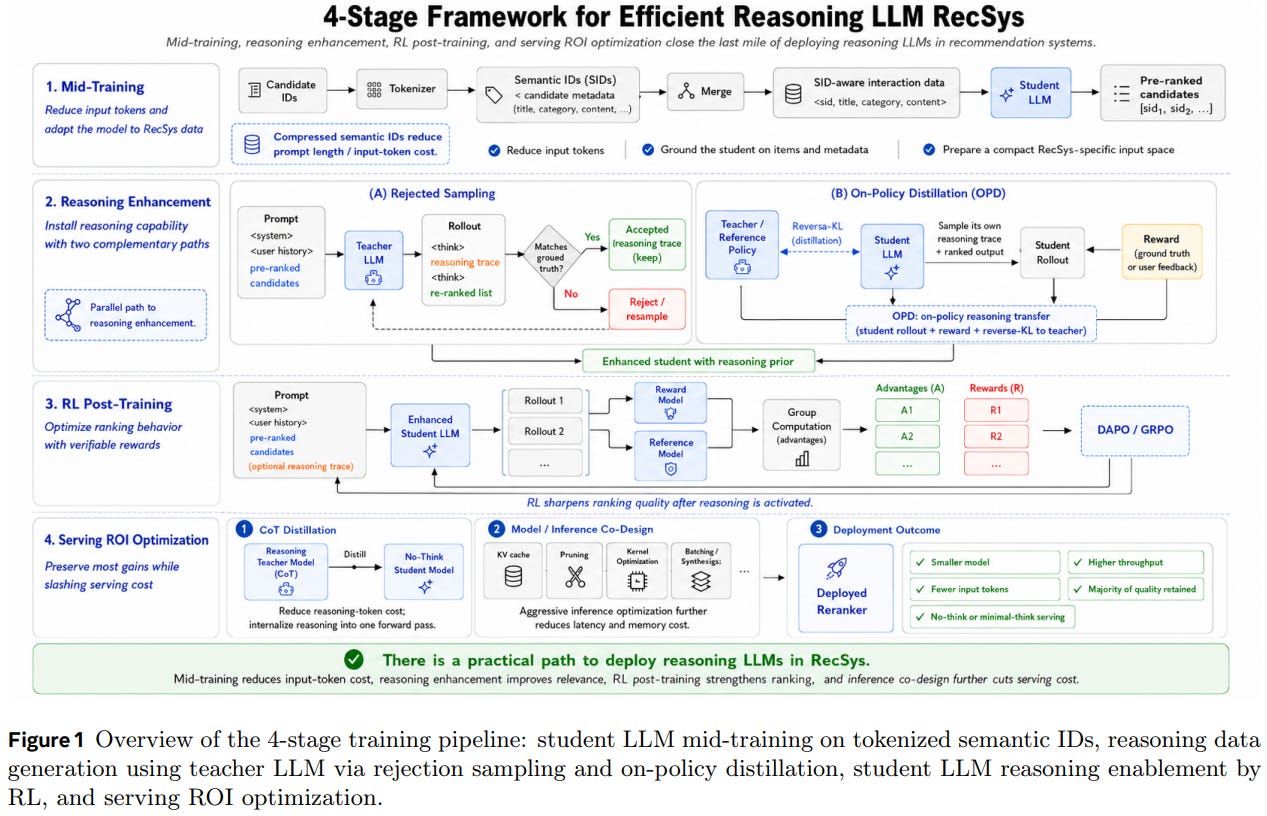
This paper from Meta presents GR2 (Generative Reasoning Re-Ranker), a framework for applying LLMs to the final re-ranking stage of industrial recommendation systems, a stage most prior work has neglected in favor of retrieval and early ranking. The authors build it in four stages. First, they mid-train a student LLM (like Qwen3-8B) on semantic item IDs from a tokenizer with over 99% uniqueness, which lets the model reason over billions of catalog items that would otherwise sit outside its vocabulary. Second, they install a reasoning prior by distilling chain-of-thought traces from a stronger teacher using targeted and rejection sampling. Third, they run RL post-training with DAPO and verifiable rewards built around per-impression AUC and NDCG. A key finding here is that reward design matters a lot. Without conditional rewards, the model games the system by just preserving the incoming order or exploiting position bias, so they add gates that zero out the ranking reward when the model cheaply copies a suboptimal input order. Finally, they cut serving cost with a context compressor that trims input by over 80% at equal quality, on-policy distillation (OPD) that recovers 82% of a 32B teacher’s gain in a 1.7B student, and a second RL pass that internalizes reasoning so the deployed model skips explicit CoT generation entirely. Two takeaways stand out: naive SFT collapses at industrial scale where OPD succeeds, and OPD supplies the reasoning while RL sharpens ranking, with neither sufficient alone.
📚 https://arxiv.org/abs/2606.31984
[5] How Do LLMs Cite? A Mechanistic Interpretation of Attribution in Retrieval-Augmented Generation
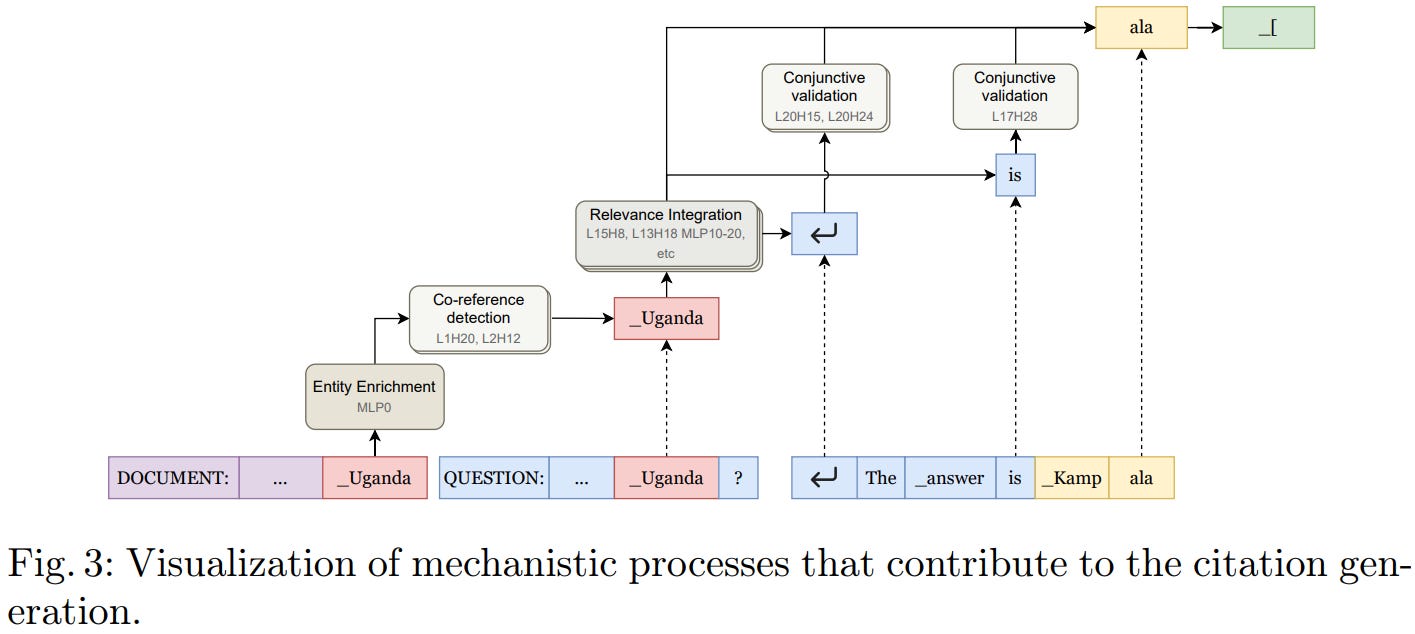
This paper from University of Amsterdam investigate Llama-3.1-8B-Instruct to figure out how it actually decides whether to attach an inline citation when answering a factoid question in a RAG setup. The authors create a clean controlled experiment by taking PopQA questions and running each one twice, once with a supporting document and once with a structure-matched distractor. Then they use activation patching to see which internal components flip the model’s preference between starting a citation (”[”) and just ending the sentence. Rather than a single “citation head,” they find a distributed and fragile “attributional ensemble” of attention heads and MLPs that operates through conjunctive, AND-like checks, meaning it’s easy to break by corrupting any of several sites but hard to induce with a single patch. The mechanism runs in three stages: an early MLP enriches the queried entity where it first appears in the document and marks it as grounded, a mid-layer processing hub (roughly layers 10-20) propagates relevance, and late layers aggregate everything at the answer token to push the citation marker over the termination token. Their core finding is that citation decisions lean on shallow entity co-reference matching rather than genuine use of document content, and the answer representation itself isn’t a decisive driver, so an inline citation can be generated by a heuristic running in parallel to answer construction. So, a citation being present tells little about whether the model actually used the source, which is a problem for RAG citations in high-stakes settings.
📚 https://arxiv.org/abs/2606.28358
[6] From Extraction to Navigation: Progressive Retrieval with Indirectly Infinite Depth
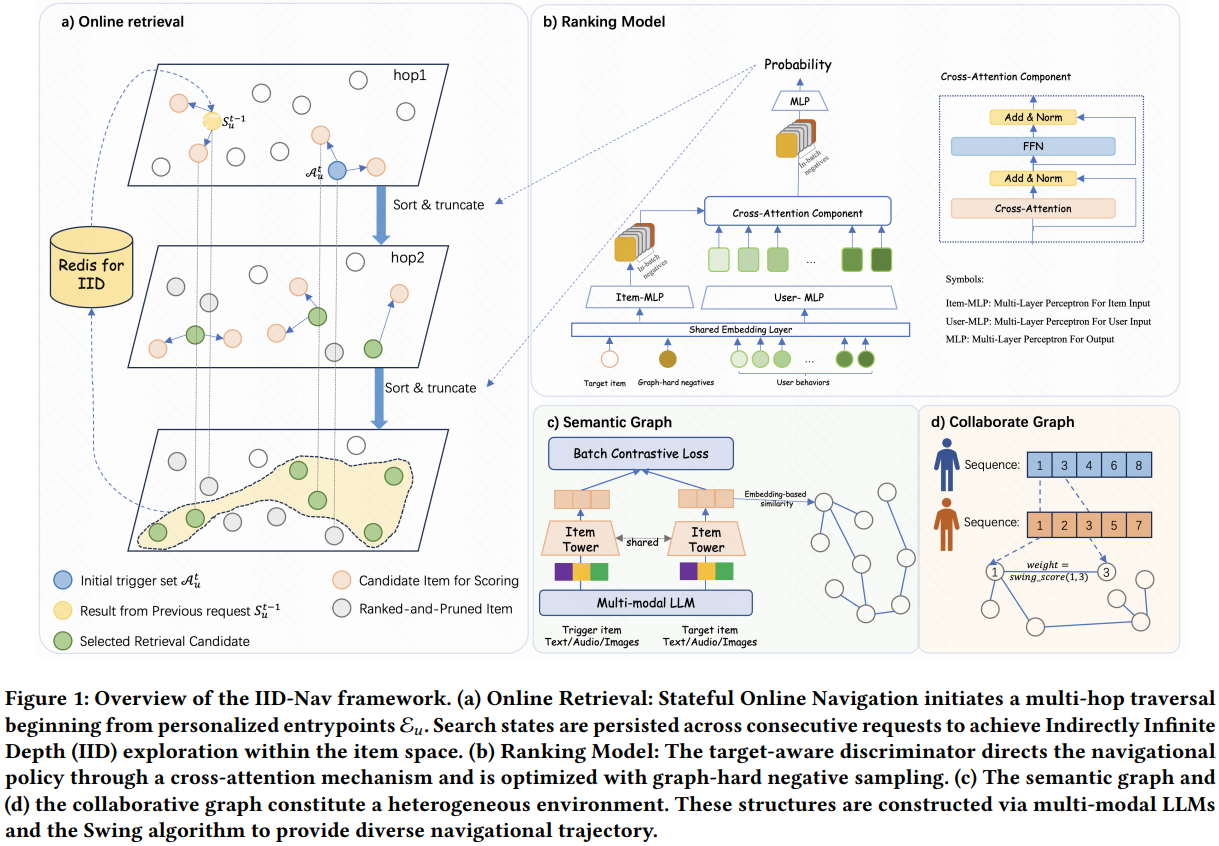
This paper from Kuaishou reframes large-scale recommendation retrieval as active navigation rather than static similarity lookup. The authors target two failures of existing methods: the “interest tunnel,” where rigid index structures trap search within a user’s familiar behavioral clusters, and “search drift,” where trajectories stray away from real intent as search goes deeper. Their key idea is Indirectly Infinite Depth (IID). Instead of cramming deep exploration into one latency-bound request, the system caches high-value terminal nodes from each search in Redis and feeds them back as starting points for the next request, so exploration depth accumulates across a user’s sessions without adding per-request latency. Each request runs a fixed two-hop traversal over two graphs (a Swing-based collaborative graph and an LLM-built semantic graph), with a target-aware cross-attention discriminator scoring and pruning candidates at every hop to keep the path aligned with current intent. To fight drift, they train the discriminator with graph-hard negatives (items that are topologically close but weakly connected) using a combined InfoNCE and margin-ranking loss. They also seed each search from personalized anchors that mix recent activity with reactivated older interests rather than fixed global entry points. On MovieLens, Taobao, and a billion-scale short-video dataset, IID-Nav posts large Recall gains (up to +50% Recall@50) over DSSM, Kuaiformer, TDM, NANN, and StreamVQ while holding competitive QPS, and a week-long A/B test showed modest but consistent engagement lifts.
📚 https://arxiv.org/abs/2606.29970
[7] Why Advanced Encoders Lag on Sparse Retrieval? The Answer and an Approach to Bridging Vocabulary Gaps
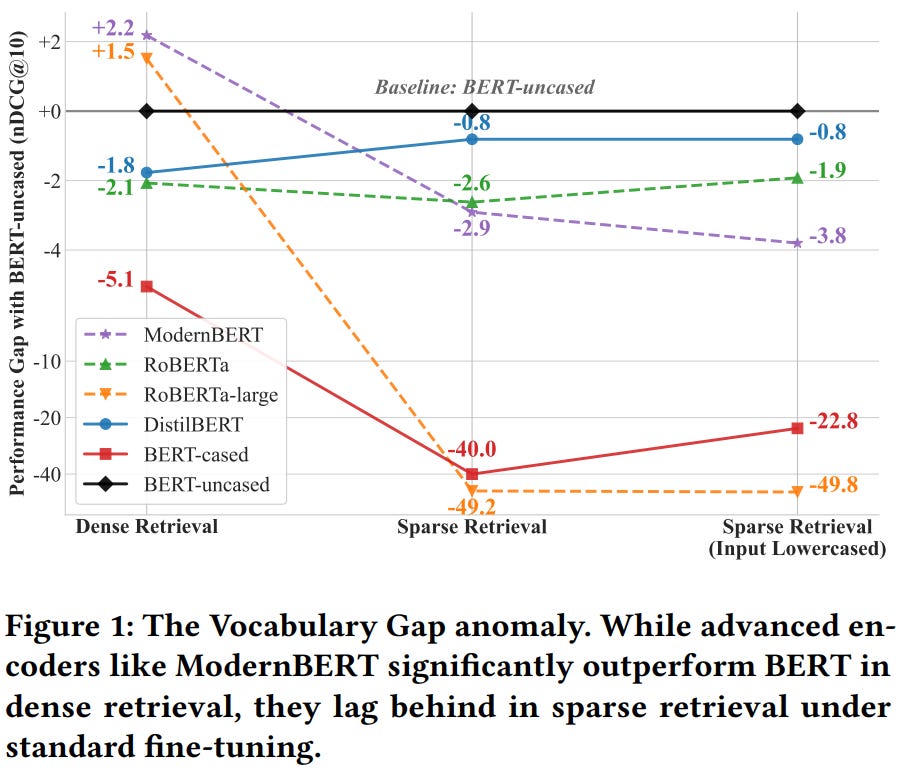
This paper from AWS explains the counterintuitive finding that modern encoders like ModernBERT beat old BERT-base at dense retrieval but fall behind it at learned sparse retrieval (LSR). The authors trace the cause to what they call the “vocabulary gap.” Modern tokenizers use raw, case-sensitive vocabularies built for lossless text reconstruction, so they split a single semantic unit into redundant surface forms (”Token” vs “token”), which wastes model capacity on morphological noise and hurts the lexical matching that sparse retrieval depends on. They rule out the obvious culprits by showing bert-base-cased (same tokenizer as the working uncased baseline) also fails, and that simply lowercasing inputs isn’t enough since it breaks tokens. The fix is Vocabulary Transfer (VT), a cheap, model-agnostic recipe that migrates a pretrained backbone onto a normalized target vocabulary (bert-base-uncased) in three steps: a Semantic Initialization that places new tokens via sparsemax-weighted barycentric interpolation over shared anchor embeddings, a prior-aware bias transfer, and a short frozen-transformer MLM phase paired with Activation Potential Calibration (APC) that shifts the output bias to avoid the dead-neuron and dense-collapse failures under SPLADE’s ReLU sparsity. VT uses under 0.2% of ModernBERT’s original training tokens and hits near-optimal results in about 500 MLM steps. Empirically it pushes ModernBERT to a new sparse-retrieval SOTA on BEIR, revives RoBERTa-large from a completely broken state, and carries over to inference-free retrieval and domain-specific vocabularies like chemistry.
📚 https://arxiv.org/abs/2607.00004
👨🏽💻 https://anonymous.4open.science/r/vocab-transfer/
[8] Can Language Models Actually Retrieve In-Context? Drowning in Documents at Million Token Scale
This paper from Gollapudi et al. asks whether a language model can act as a retriever by reading a whole corpus in-context and directly generating the ID of the relevant document, rather than relying on vector search. The authors build BLOCKSEARCH, a small 0.6B model based on Qwen3 that uses block-sparse attention, randomized per-document ID codes, in-batch negatives, and an on-policy auxiliary loss. It matches a dense retriever at small corpus sizes and generalizes about 10× past its training context, but recall collapses to near zero once corpora approach a million tokens. They trace this collapse to attention dilution: even at huge scale, the gold document still gets the highest raw pre-softmax attention score in at least one head, but as distractors pile up they swamp the softmax denominator, so the gold document’s normalized attention mass and its contribution to the layer output shrink drastically while overall output magnitude stays roughly constant. This failure is a readout problem, not a ranking problem. To fix it, they try length-aware softmax tweaks (an additive learned sink, which barely helps, and SSMax score rescaling by log N, which holds up well) plus document-level top-B routing that prunes the context before the retrieval layers. With these changes the model recovers most of the gap to dense retrieval at million-token scale on MS MARCO and NQ, matches or beats the concurrent MSA-4B model at roughly one-seventh the parameters, and on LIMIT beats dense retrieval by nearly 3x. One caveat is that performance still trails the near-perfect internal attention ceiling and keeps declining with N, so attention dilution is mitigated but not solved.
📚 https://arxiv.org/abs/2607.01538
[9] As We May Search
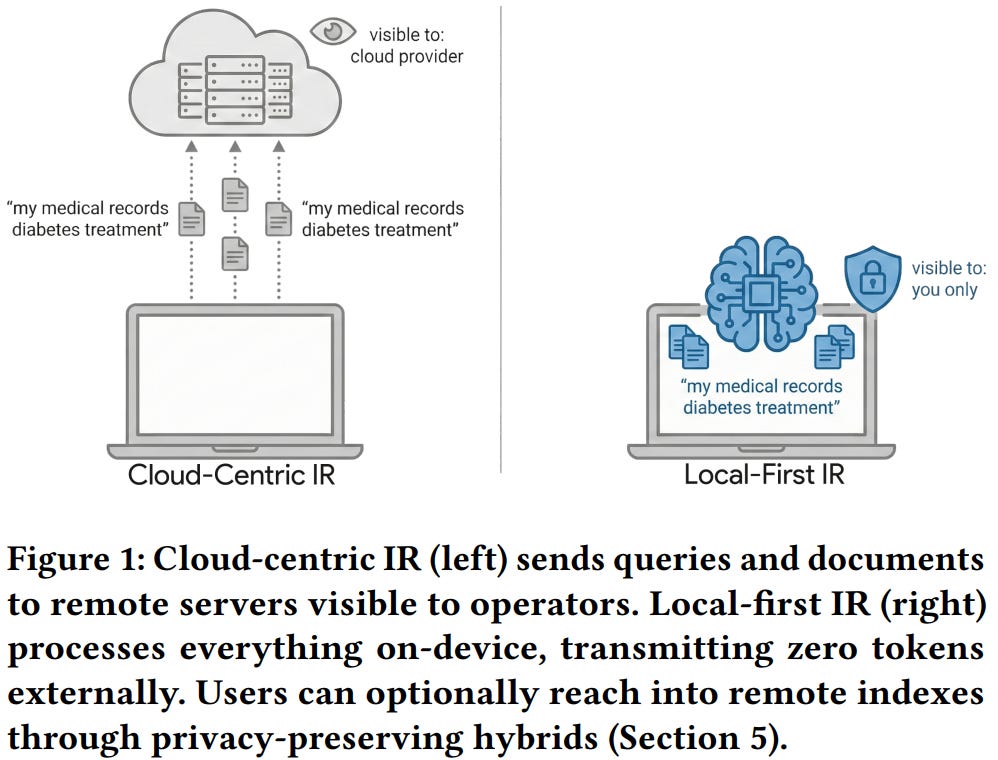
This paper from Zerhoudi et al. argues for local-first information retrieval. It is a design philosophy where the search index, embedding model, and language model all live on the user’s own device, and the cloud becomes optional rather than required. The motivation is privacy. Current RAG systems (ChatGPT, Perplexity, NotebookLM) can search your personal documents but only by shipping them to someone else’s server, where every query reveals intent and every document enters infrastructure you don’t control. The authors contribute a framework that organizes retrieval architectures along three axes (privacy/control, capability, accessibility), then back it with experiments on ordinary consumer hardware (an Apple M1 laptop and an entry-level x86 machine) scaling from 1K to 1M documents across dense retrieval, BM25, and hybrid fusion. They find that quality degrades gracefully. Dense retrieval holds above 91% nDCG@10 up to 100K documents with sub-30ms queries, and approximate HNSW indexes push that to 1M documents at 11ms queries for only a 2% quality hit. The expensive part is the one-time embedding pass (47 minutes at 1M on a flat index, cut to ~3 minutes once embeddings are cached), so they recommend a three-tier recipe: serve BM25 instantly, swap in IVF, then settle on HNSW. On the generation side, a 7B model running locally via Ollama lands within 4 points of a gpt-4o-mini cloud baseline on answer quality. They also propose an embedding-only bridge for reaching remote indexes when local scope runs out, transmitting a 384-dimensional vector to get 99.9% of retrieval quality with zero token exposure and no recoverable entities. The authors also point out that embedding inversion attacks make this a practical improvement rather than a formal privacy guarantee.
📚 https://arxiv.org/abs/2606.29652
👨🏽💻 https://github.com/searchsim-org/ictir26-localfirst-ir
[10] CMSL: Constructive Multi-Sequence Learning for Recommendation Systems
This paper from Meta introduces CMSL (Constructive Multi-Sequence Learning). Most sequential recommenders treat a user’s history as one long chronological sequence, like a sentence fed to a language model. The authors argue this breaks down because user behavior isn’t coherent the way text is. It’s a messy mix of unrelated interests, stray clicks, and accidental interactions, so cramming everything into a single attention context creates what they call “context pollution,” where unrelated behaviors compete for the same attention budget and dilute the signal for what the user actually wants right now. Their fix is to stop treating history as a fixed prompt and instead actively construct it. A learnable module splits the raw history into multiple “pure” thematic strands in latent space, using cross-attention conditioned on non-sequence context to disentangle intents, then runs self-attention separately within each strand so competing interests don’t interfere. Because running attention across many sequences is expensive, they approximate Meta’s HSTU attention with a linear-time mechanism built on a Taylor expansion of the SiLU activation plus a sparse kernel for the large entries. They also compress the constructed sequences back into one per layer to keep the count from exploding across depth. Deployed across five surfaces at Meta on billions of daily users, CMSL delivers positive online A/B lifts in retrieval.
📚 https://arxiv.org/abs/2606.28533
Extras: Benchmarks
⏱️ STEB: Style Text Embedding Benchmark
STEB (Style Text Embedding Benchmark) is an open-source benchmark for evaluating text embeddings on style-focused tasks, addressing the lack of standardized evaluation for style representations. It comprises 96 datasets spanning 7 languages and organizes evaluation across five task types, including clustering, pair classification, retrieval, order alignment, and probing, covering applications such as authorship verification, authorship retrieval, AI-generated text detection, and linguistic feature analysis.
📝 https://arxiv.org/abs/2606.31741
👨🏽💻 https://github.com/rrivera1849/STEB
I hope this weekly roundup of top papers has provided you with valuable insights and a glimpse into the exciting advancements taking place in the field. Remember to look deeper into the papers that pique your interest.
I also blog about Machine Learning, Deep Learning, MLOps, and Software Engineering domains. I explore diverse topics, such as Natural Language Processing, Large Language Models, Recommendation Systems, etc., and conduct in-depth analyses, drawing insights from the latest research papers.